Anyone who has worked near a soap production line knows that the packing section is where things either run smoothly or fall apart. And the number everyone keeps one eye on -operators, supervisors, plant heads -is the PPM on the machine screen.
PPM means Pieces Per Minute. It tells you how many soap bars your machine is wrapping every minute. The calculation is simple, but what actually drives that number in real production is a different conversation altogether.
How Soap Packing Machine Speed is Calculated
The formula is straightforward. Divide the total units packed by the total running time in minutes, and you get your PPM.
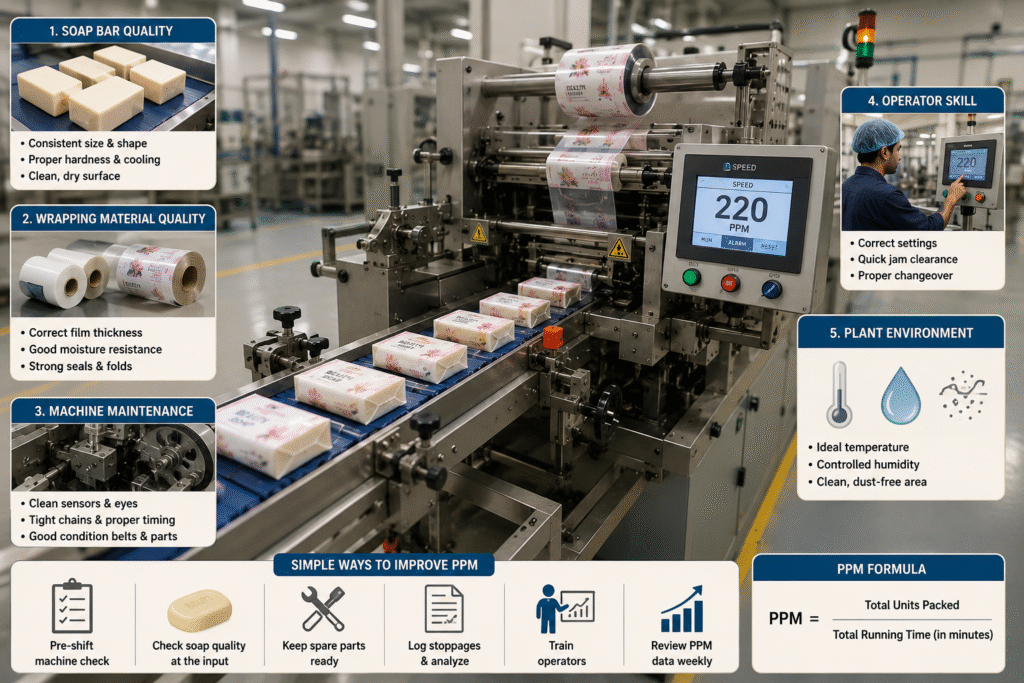
PPM = Total Units Packed ÷ Total Running Time (in minutes)
If your machine packed 10,000 bars in 50 minutes, your soap packing machine speed is 200 PPM. Simple math.
Machine manufacturers calculate it differently, though. They base the rated speed on the main drive cycles -camshaft or servo motor revolutions per minute. That gives a theoretical maximum measured under perfect conditions. On the floor, what you actually track is effective PPM, which factors in small stoppages, jams, and rejects. This number is always lower than the spec sheet figure, and that is completely fine.
A healthy benchmark for most soap lines is running at 80% to 90% of the rated speed. A machine rated at 300 PPM should realistically hit 240 to 270 PPM during a normal shift. Consistently falling below 75% means something specific is pulling you down.
What Affects Soap Packing Machine Speed in Real Production
1. Soap Bar Quality at the Input
The packing machine only performs as well as the soap it receives. Bars that are inconsistent in size, too soft, or not cooled properly cause misfeeds and rejects right from the start.
- Soft or warm bars deform on the conveyor and mess up wrap alignment
- Size variation from the stamping section triggers sensor rejects
- Bars that have not cooled enough stick together and cause double-feeds
Many supervisors focus all their attention on the packing machine when speed drops. Often, the real problem is at stamping or cooling, three stations back.
2. Wrapping Material Quality
Poor quality film or paper is one of the most common reasons soap packing machine speed drops, and it often goes unnoticed for days.
- Uneven film thickness causes tension issues and mid-run breaks
- Moisture in paper wrappers leads to tearing during folding
- Low-grade glue in fold-wrap machines creates open packs and forces line checks
Switching to a better material supplier has fixed speed problems in several plants without any mechanical change at all.
3. Machine Maintenance
Wear happens slowly, so teams often get used to running slowly without realising it has gotten worse over time.
- Worn conveyor belts disrupt the feed rhythm between bars
- Dusty sensors throw false rejects and stop the line unnecessarily
- Loose timing chains cause misalignment in the wrapping cycle
A 20-minute weekly check catches most of these before they actually cost output.
4. Operator Skill
A trained operator keeps the machine running close to rated speed even when small issues come up. An untrained one stops the line for things that do not need a stoppage.
- Wrong film tension setting wastes time and causes breaks mid-run
- Slow jam clearance adds idle time to every shift
- Incorrect changeover settings reduce speed for the entire next run
5. Plant Environment
Temperature and humidity affect both soap and film behaviour during packing. High humidity makes soap sweat slightly, which causes sticking on conveyors. Dusty environments clog sensors and air jets. Cold weather makes some wrapper films brittle at fold points.
Simple Ways to Improve Your Soap Packing Machine Speed
- Run a quick pre-shift check on sensors, film tension, and conveyor before the run starts
- Check the soap bar quality at the input before it reaches the packing section
- Keep high-wear spare parts in stock so a small breakdown does not become a half-day stoppage
- Log every stoppage with a reason -patterns become visible fast when you have the data
- Give operators hands-on training, not just a manual to read
- Review PPM data weekly and investigate any drop more than 10% below your usual average
None of these needs capital investment. Most of them are just consistency and attention, and the output improvement shows up quickly.
To Sum It Up
Soap packing machine speed tells you a lot about how the whole production line is functioning, not just the packing section. The PPM calculation is easy, but keeping that number healthy takes attention to soap quality, material, maintenance, and the people running the machine. Fix the friction points one by one, and the numbers follow.
Explore advanced soap packing machines designed for high-speed wrapping, smooth operation, and efficient production performance.
FAQs
Q1. What is a normal PPM for a soap packing machine?
Most standard automatic machines run between 150 and 300 PPM. High-speed lines can go higher, but 200 to 250 is common for mid-range setups.
Q2. My machine is rated 300 PPM, but I am only getting 200. Why?
Check soap bar consistency, film quality, and sensor cleanliness first. These three cover most speed loss cases before you start looking at mechanical problems.
Q3. Does soap bar size affect packing speed?
Yes. Bigger bars need a longer cycle time per piece, which brings PPM down. Always get the rated speed for your specific bar size, not just the general max figure.
Q4. Can I improve speed without buying a new machine?
Most of the time, yes. Better maintenance, consistent input quality, and trained operators can close a 20 to 30 PPM gap without any capital spend.
Q5. What is OEE, and should I track it?
OEE stands for Overall Equipment Effectiveness. It shows how efficiently your machine runs vs its potential. Track it -anything below 75% consistently means real losses to fix.
Stay connected with us on YouTube for the latest updates on soap packing machines and packaging automation solutions.